

Sébastien Thibault for FP Analytics
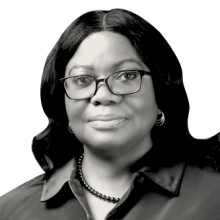
Iyabo Masha
is the Director of the Intergovernmental Group of Twenty-Four on International Monetary Affairs and Development
Global financial institutions like the World Bank Group and International Monetary Fund (IMF) play a critical role in mobilizing resources to help countries meet development goals, but increasingly, many countries are seeking a seat at the decision-making table and voicing their concerns about the governance of these institutions.
In an interview with FP Analytics, Dr. Iyabo Masha—Director of the Intergovernmental Group of Twenty-Four on International Monetary Affairs and Development (G-24)—talked about the need for more equity in voting power and other ways international financial institutions could pivot to achieve the kind of progress needed for today’s global challenges such as digitalization and climate change. The following transcript has been edited for length and clarity.
FP Analytics (FPA): What is the role of international financial institutions in leading global governance, particularly on cross-border challenges like climate change and financing for development?
Iyabo Masha (IM): As I see it, there are three main roles. One is leadership that transcends national borders, which is important for shared challenges like climate change and sustainable development. Institutions like the World Bank, the IMF, and regional development banks provide legitimacy. They can convene and forge collective solutions to cross-border issues. They bring diverse countries together, and they’re able to coordinate different interests.
The second role is resource mobilization. The quantity of financing required to achieve development goals is at a scale that individual countries cannot achieve alone. These institutions pool financing, share risks, and even mobilize funds from the private market, which makes them central to the achievement of climate goals and the United Nations Sustainable Development Goals. They provide expertise and design strategies that many countries with low capacity would not be able to develop alone.
The third role is preserving global financial stability. In addition to what they do at the country level, the IMF is specifically charged with maintaining global monetary and financial stability both on a long- and short-term basis, due to its ability to respond immediately to crisis in countries. So, the international financial institutions have the mandate to act on those three areas.
FPA: In your view, are the World Bank and the IMF still meeting those mandates?
IM: I would say that the evidence is mixed. The World Bank and IMF are fulfilling parts of their mandates, and their tools are regularly reviewed and updated as the global situation changes. But in today’s world, they have fallen short in what matters most. Look at the scale of some of the challenges of the 21st century: climate-related issues and environmental disasters, inequality both within countries and across countries, to name a few. The World Bank Global Economic Prospects 2025 report recognized that based on current policies, 20 of the 26 poorest countries today will remain poor in the year 2050. Many of these countries are in sovereign debt distress, they face unanticipated climate shocks, and their economic prospects are negatively impacted by digital disruption and geopolitical fragmentation. These challenges require the modification of existing or introduction of new lending tools.
For example, in 2023 the World Bank introduced the Climate Resilience Debt Clause in loan agreements, which allows for the deferral of a country’s debt repayments in the event of a severe climate shock or natural disaster. In another case, the IMF approved the voluntary transfer of the IMF Special Drawing Rights (SDRs) from economically stronger member countries to more vulnerable, low- and middle-income countries. This created additional financing to support sustainable development and address global challenges like climate change in vulnerable countries. These are examples of reforms of existing instruments that enable these organizations to be more effective, to be better able to meet their mandates. But more is needed. For example, the sovereign debt crisis cannot be resolved based only on the tools available today at the IMF and the World Bank. So, while I can say that the institutions are making some progress, it’s not enough for the challenges that face the world today.
FPA: What are the most critical reforms international financial institutions can pursue to most effectively meet those challenges and provide greater equity in terms of the people and countries they serve?
IM: Governance and representation are very important to achieving a more equitable, effective institution. The World Bank and IMF have to rebalance their governance frameworks. The voice and representation of emerging markets and developing countries remains low relative to their size in the global economy. The voting power and the leadership selection process should better reflect the current global economy. Inclusivity is vital. Low-income countries need to be at the table within the managerial and board processes so they can better articulate their own concerns. And transparency and accountability are key. Some of the multilateral development banks have accountability frameworks, and some do not. These are frameworks that help make the decision-making process more open and give a clear channel for civil society to contribute to the process.
In addition to those vital governance issues, there is the question of resource mobilization. According to the UN Financing for Sustainable Development Report 2024, an additional USD 4 trillion is needed annually to achieve the Sustainable Development Goals. Yet, the World Bank Group’s total commitment to countries and private businesses in 2024 was just USD 117.5 billion, around 2.9 percent of the global needs. This speaks to the need for institutions to scale up development finance by further expanding their balance sheet, and be more proactive in mobilizing private finance at scale and at affordable cost. There has to be a debt resolution mechanism, because the current debt resolution framework is not working, it is causing countries to wallow in debt and not be able to meet their obligations to their citizens on education and health as a result.
Another area for growth and reform is on climate-related issues. The international financial institutions have done some work on integrating climate into their operations, but more needs to be done. For example, how should they revise the methodology of the Debt Sustainability Framework so that it does not constrain the financing of investments needed to address resilience, adaptation, and climate vulnerabilities? And there is also the issue of how to make the IMF more agile when it comes to responding to crises, particularly to help the countries that are solvent but illiquid so that a liquidity problem does not become a solvency problem. Given that existing instruments are designed for individual countries, and considering the time it takes for an IMF program to be initiated and agreements to be reached, an IMF-managed but market-based mechanism, as proposed by the Latin American Committee on Macroeconomic and Financial Issues (CLAAF), could better support this category of countries.
Beyond these issues, there is the question of coordination among financial institutions and whether they are ready for the challenges of the digital age. Over the past few years, we’ve seen how digitalization is changing almost everything about the world as we know it. For example, in many countries, even advanced economies, many jobs are going to be lost as a result of digitalization. At the same time, many new sectors are growing. So, what is going to happen? How do countries now proactively make labor market reforms that will enable them to take advantage of the opportunities that are arising while at the same time mitigating the risks? It is not clear which way digitalization is going, what role money is going to play in the future, how the monetary system will be affected by crypto as a financial asset, or how any of these issues will impact the ability of countries to maintain monetary and financial stability. The question becomes: What issues should countries be forward-looking about at present in order to better prepare themselves for these kinds of disruptions? The IMF and World Bank are doing quite a bit of work in that area in the context of the Financial Sector Assessment Programs and the Global Financial Stability Report. But there needs to be more ambition, greater agility, and better coordination with countries so they can be better prepared when disruptions happen.
FPA: In the past, reforms have been attempted but have been stalled or weakened by resistance from majority shareholders. Do you see any signs that kind of dynamic is changing or shifting?
IM: Well, it looks like it’s still there, maybe even worse now because of the geopolitical fragmentation that has been part of the global scene in the past three, four years. Geopolitical fragmentation is a major obstacle to reform, as is the fact that the governance structures of the IMF and World Bank still reflect the global economy of 2010 and 2018, respectively, the last review period. Governance structures are still not reflective of the fact that many emerging market and developing countries have made substantial progress in recent years. Some are now part of the 10 largest economies. And so this needs to be reflected in the decision-making process. But there are other challenges like resource constraints. Obviously, this requires not only mobilizing resources from outside but also changing the shareholder contributions, which could happen through governance reforms. There are fiscal constraints obviously in many donor countries, which means that putting more money into these organizations may be politically difficult for them at the moment. So, I think these challenges have to be addressed in order for us to create the room to even have discussions about these reforms.
FPA: What are the current opportunities to push for reforms, and how can actors both within multinational institutions and also from the outside, like civil society, take action in this moment?
IM: We’ve seen that the world tends to come together when there’s geopolitical crisis. Crisis creates the opportunity to sit down and forge collective solutions and reforms that will then last for the next few decades. Now, the Global South is becoming more assertive in demanding some of these reforms and innovations because of its increasing share in the global economy. Our group, the G-24, and other coalitions are making those voices heard. The private sector is also becoming more engaged on the issues. At the Fourth International Conference on Financing for Development, in Seville, Spain, I was quite impressed by the participation of the private sector. By that, I mean the ratings agencies, the investment banks, the insurance corporations—private-sector actors were coming to the table to be part of the discussion. I think that momentum is strong and can help create the environment that makes diplomacy and discussions possible.
FPA: What are the current and longer-term priorities of the G-24 for reform of the international financial architecture?
IM: When the G-24 was founded in 1971, it was focused specifically on the agenda of the Bretton Woods Institutions—ensuring that the voices of the Global South were heard and pushing for a fairer perspective when it comes to discussions on the agendas of the multilateral institutions. But over the years, as the global economy has changed, we have also changed and become the platform for the coordinated position of the Global South on these issues.
Our work is evidence-based. We do a lot of research and technical work, which then equips our member countries when they engage on these issues within the multilateral system. While there are currently many issues on our plate, there are two main priorities. For now, our focus is on global economic governance reform. That is, quota and governance reform, because these institutions are established as quota-based organizations, and to maintain their integrity, they have to adapt to the system. We have internally done a lot of different scenarios on what it would look like if certain parameters relating to how the quota is currently allocated are changed. As an organization, we have internal issues, because some of the scenarios we have developed actually show that some of our members may give up some of their quota in order for some other members to increase theirs though a revised quota formula. We manage these issues together and continue to strategize on how we can get a more equitable distribution of the quota.
The second issue at the top of our agenda is domestic resource mobilization and the reform of international tax cooperation. Given the low growth rates in many countries and limited access to external financing, the reform of international tax cooperation is absolutely vital to mobilizing more resources for developing countries to finance their climate and development goals. And so we are focusing a lot on reforming aspects of international tax cooperation that are cross-border in nature. This includes corporate tax, illicit financial flows, and other taxation issues. We’ve been very much involved in the Organisation for Economic Co-operation and Development tax framework in the past, but we’re also involved in the new framework being developed within the U.N., which we hope will create a kind of international tax cooperation that will be fair to developing countries and enable them to mobilize enough resources to meet their development goals. So, we see ourselves as a catalyst for reform. We continue to engage in all these different areas and very much welcome the coordination and collaboration we have with civil society and think tanks that are working in our areas of interest.
Dr. Iyabo Masha is the Director of the Intergovernmental Group of Twenty-Four on International Monetary Affairs and Development (G-24). From 2019 to 2022, she was a member of Nigeria’s eight-person Presidential Economic Advisory Council, which directly advises the president on economic policy. Prior to that, she worked for two decades in a range of countries at the International Monetary Fund in Washington, D.C., negotiating IMF lending programs and developing nonprogram policies for emerging markets and developing economies in Africa and Asia. She also served as the IMF’s resident representative for Sierra Leone. Dr. Masha joined the IMF from the Central Bank of Nigeria in 2003 following a career focused on monetary policy and operations, reserve management, and research.
More on Debt Architecture

Fixing Foreign Aid
Episode 1: How have the recent cuts in foreign aid impacted countries in the global south? And how did so many countries become reliant on foreign aid to begin with?
Tackling Sovereign Debt
Episode 2: How can we ensure countries looking to finance their future don’t have to mortgage away their present?
Reforming Global Finance
Episode 3: What can the World Bank and International Monetary Fund do to ensure more countries from the global south have a seat at the table?